


Autonomous Agentic Workspace for Enterprise Engineering
24/7 Autonomous Agent Orchestration Across Cross-Functional Teams for Our B2B Partner
Industry & Scale
Product Engineering · Enterprise
Platform Integration
Global Tech Enterprise · Next.js · Typescript · Express.js

“The agentic workspace developed by Weblinear fundamentally shifted how our engineering pods collaborate. Our release velocity multiplied without sacrificing quality.”
Chief Technology Officer
Global Enterprise Software Group
Quantified Performance Impact
70%
Manual Effort Cut
Routine pull request turnaround dropped from 36 hours to under 4 hours.
24/7
Autonomous Coverage
Continuous monitoring and auto-remediation of low-priority infrastructure alerts.
4.8x
Deployment Velocity
Faster quarterly release cadence, with no increase in engineering headcount.
99.98%
Uptime SLA
Sustained high-availability SLA across production environments.
Operational Context
Modern enterprise engineering organizations rarely suffer from a shortage of talent. Instead, they hit an invisible velocity ceiling created by coordination friction: as the organization scales beyond a dozen squads, the overhead of synchronizing pull requests, continuous integration pipelines, cross-service dependencies, and infrastructure alerts grows exponentially.
Our client, a global technology enterprise managing a 14-pod distributed engineering organization across Tokyo, London, and San Francisco, had reached this exact inflection point. With hundreds of microservices deployed across hybrid cloud environments, engineers spent more than 40% of their weekly capacity navigating manual handoffs: waiting for code reviews across time zones, investigating flaky CI/CD test failures, manually coordinating multi-service staging deployments, and context-switching to triage low-priority alerts.
Weblinear designed and engineered the Autonomous Agentic Workspace on Weblinear MAC (Microservices Architecture & Connectivity). Weblinear MAC serves as the central event-driven orchestration backbone, combining high-throughput Kafka streaming, Dockerized microservices, Model Context Protocol (MCP) tool servers, and specialized multi-LLM routing (Claude, OpenAI, and Gemini) into a continuous, self-governing engineering operating system.
The resulting platform codifies engineering handoffs into autonomous workflows, allowing code review, regression triage, staging dispatch, and health remediation to run 24/7 with zero human latency, while engineering leads maintain strict control through interactive Slack approval gates and an audited Next.js Command Center.
Challenges Before Implementation
Operating at the scale of 14 distributed squads across multiple continents created systemic operational bottlenecks that traditional project management and static dashboards could not resolve:
Fragmented CI/CD pipelines and manual release handoffs: QA, staging, and production environments operated on detached deployment scripts with no automated coordination between squads, creating multi-day staging bottlenecks and deployment lockups.
Severe code review latency and reviewer fatigue: Routine pull requests waited up to 36 hours for code inspection. Senior engineers were constantly interrupted to review trivial syntax, style deviations, or basic edge cases, pulling their attention away from high-leverage architectural initiatives.
Low-priority infrastructure alerts and triage burnout: On-call SREs and platform engineers spent dozens of hours each week triaging transient memory spikes, container restarts, and flaky end-to-end test failures that did not require human intuition but still consumed valuable engineering bandwidth.
Cross-pod coordination friction across time zones: When services had interdependent schema or API contract changes, squads had to manually coordinate merge sequences over asynchronous chat threads, leading to recurring regression cascades in staging.
Tooling silos and missing context continuity: GitHub, Slack, local VS Code environments, Jenkins, and Sentry operated as isolated data islands. Engineers lacked a unified lineage connecting a pull request diff to its test trace, deployment status, and production telemetry.
The organization was constrained by coordination overhead, not engineering capability, scaling linearly in communication complexity with every new engineer hired.
Strategic Approach
Weblinear recognized that traditional engineering organizations attempt to solve coordination friction by introducing more bureaucratic process, such as additional approval gates, longer standups, and complex manual spreadsheets. That approach slows velocity and accelerates engineer burnout.
Instead, Weblinear engineered the Agentic Workspace to solve coordination structurally through an event-driven autonomous architecture built on Weblinear MAC (Microservices Architecture & Connectivity).
Rather than relying on human relays to triage pull requests, trigger builds, and investigate test traces, the platform models every engineering signal, such as a git commit, an open pull request, a failing test log, or a container memory warning, as an orchestration event. Stateless agent workers powered by specialized LLMs (Claude, OpenAI, Gemini) and standardized Model Context Protocol (MCP) servers process these events in real time, executing deterministic analysis and routine remediations while reserving human judgment strictly for critical architectural approvals.
Architectural Solution
Weblinear engineered the Autonomous Agentic Workspace as an integrated, multi-tier enterprise architecture powered by Weblinear MAC, uniting cutting-edge intelligence with robust infrastructure utilities:
Weblinear MAC Orchestration Backbone: Acts as the central event-driven nervous system, orchestrating asynchronous agent workflows, enforcing security policies, managing distributed state machines, and routing events between development squads with sub-second latency.
Kafka Event Ingestion Layer (Docker Microservices): High-throughput Kafka message bus running on containerized Docker clusters that ingests, deduplicates, and buffers high-volume telemetry, including GitHub webhook payloads, CI/CD build logs, and runtime alerts, across partitioned topics with guaranteed message delivery.
Model Context Protocol (MCP) & VS Code IDE Companion: Standardized open protocol connecting local developer IDEs directly to the workspace. VS Code extensions communicate via MCP client-server bridges, allowing autonomous agents to query abstract syntax trees (ASTs), file symbol trees, and test runners directly in the developer's cursor context.
Specialized Multi-LLM Intelligence Matrix: Routes tasks dynamically across frontier AI models based on technical requirements:
Anthropic Claude: Specializes in deep AST code inspection, structural refactoring suggestions, security vulnerability (CVE) scanning, and human-readable PR review synthesis.
OpenAI Models: Specializes in complex regression root-cause diagnosis, flaky test pattern recognition, automated unit/integration test fixture repair, and stack trace deduplication.
Google Gemini: Leverages massive long-context windows to ingest entire multi-repository dependency graphs, evaluating cross-pod API contract compatibility and systemic architectural blast radiuses.
Autonomous Code Review Pods: Independent review agents that pull raw git diffs, run AST syntax checks, verify test coverage thresholds, and post constructive inline GitHub review comments in under 4 minutes with zero manual dispatch.
Regression Triaging Engine: Automatically clusters test failures, isolates flaky integration tests from deterministic regressions, identifies the breaking commit through git bisect analysis, and stages reproducible sandbox test runs.
Continuous CI/CD Dispatch (Node.js & Express): Microservices layer that manages multi-stage container builds, provisions ephemeral staging environments per pull request, and automatically retries transient infrastructure network timeouts.
Automated Health Remediation Pod: 24/7 production watchdog that monitors SLO/SLA telemetry, automatically restarting crashed container workers, reallocating memory pools, and triggering automated canary rollbacks when error-rate thresholds are breached.
Slack Interactive ChatOps: Bidirectional Slack application built with Block Kit modals that delivers contextual notifications, summarizes agent review findings, and provides one-click human approval gates for production deployments.
Next.js Command Center & PostgreSQL Audited State: High-performance TypeScript dashboard delivering live visibility into pod release cadence, agent workload distribution, and deployment pipelines, backed by ACID-compliant PostgreSQL tables that preserve an immutable audit trail of every autonomous decision.
Core Architecture Stack & Technologies
Enterprise Core Modules
Technology Stack & Infrastructure




 MAC
MAC








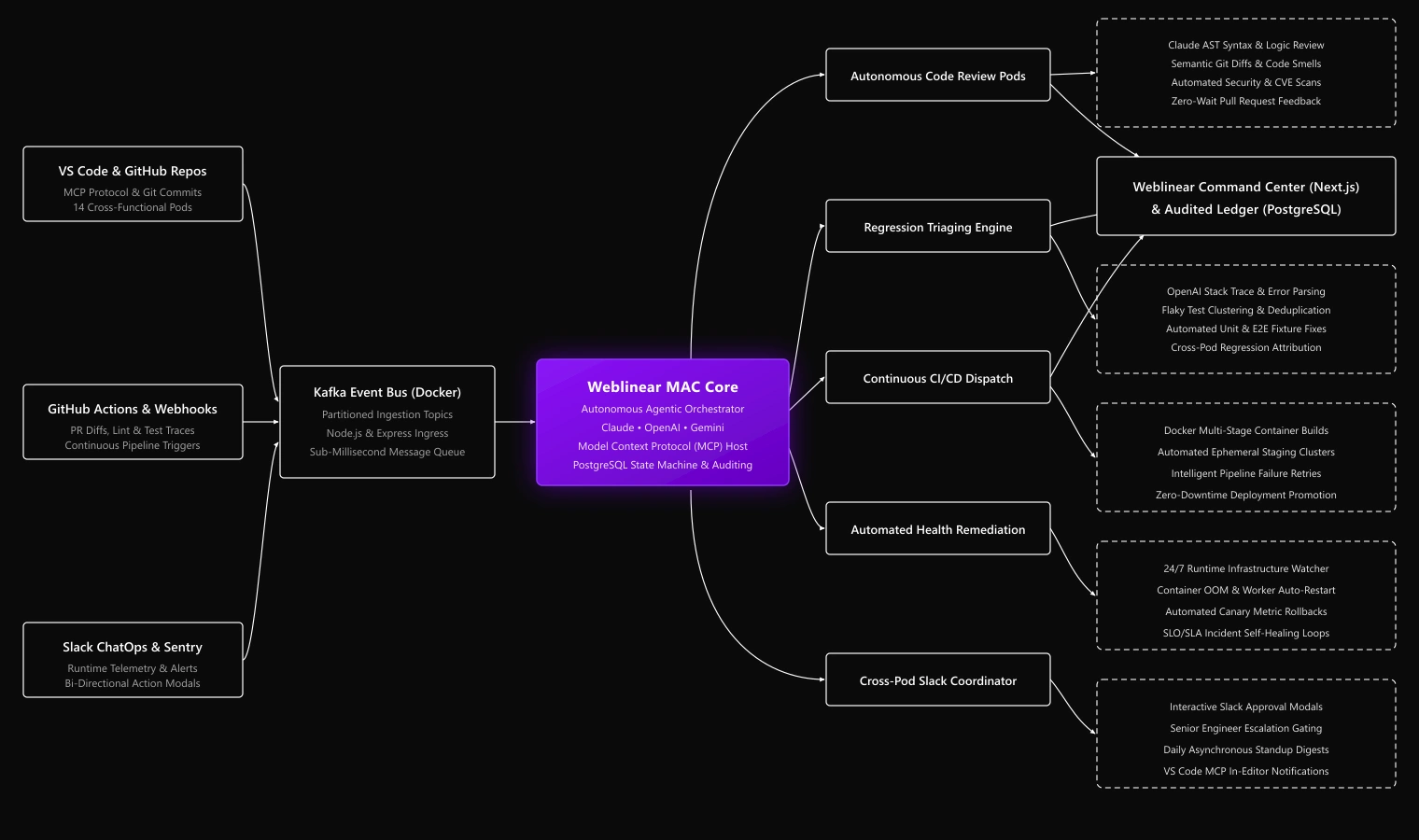
Autonomous Agentic Workspace Architecture & Topology (Weblinear MAC)
Full-stack event-driven system architecture combining Kafka event streaming, Docker microservices, Model Context Protocol (MCP), and multi-LLM orchestration (Claude, OpenAI, Gemini) over Weblinear MAC to automate code review, regression triage, and CI/CD dispatch across 14 engineering pods.
Why This Matters
Most engineering organizations attempt to solve coordination problems by adding process: more standups, more approval gates, and more static dashboards. That approach scales linearly with headcount and eventually stalls velocity entirely. Weblinear built the Agentic Workspace to solve the coordination problem structurally: autonomous systems handle the triage, routing, and low-priority remediation that used to consume engineering hours, while humans stay in control of high-leverage architectural decisions.
By unifying GitHub, VS Code, Kafka, Docker, and frontier LLMs under Weblinear MAC, the enterprise unlocked a 4.8x increase in deployment velocity while maintaining a 99.98% production uptime SLA across all 14 engineering squads.
Step-by-Step Execution Workflow
Signal Intake & Kafka Topic Ingestion: GitHub webhooks, commit pushes, and telemetry traces stream into Kafka topics partitioned by repository and pod domain with sub-second ingestion latency.
MCP-Driven Semantic Inspection & Context Assembly: Node.js microservices query repository ASTs and active Jira/Slack context through Model Context Protocol (MCP) tools, assembling complete diff context for AI agents.
Specialized Multi-LLM Evaluation & Pod Triage: Weblinear MAC dispatches payloads to Claude (code inspection), OpenAI (regression root-cause), or Gemini (cross-repo dependency check) for autonomous evaluation.
Continuous CI/CD Dispatch & Automated Staging: Passed code reviews trigger automated Docker container builds and ephemeral preview deployments with zero manual release coordination.
Interactive Slack ChatOps & Human-in-the-Loop Release: High-impact deployment gates present structured summaries and one-click approval modals in Slack, preserving senior engineering governance for critical releases.
24/7 Runtime Health Remediation & Audited State Sync: Production services run under autonomous health watchdogs, with every event, decision, and metric recorded into PostgreSQL audit logs for end-to-end traceability.
The Measurable Outcome: Routine pull request turnaround plummeted from 36 hours to under 4 hours (70% cut in manual effort), 24/7 autonomous monitoring resolved low-priority alerts, deployment velocity accelerated by 4.8x without increasing engineering headcount, and 99.98% production uptime was sustained across live clusters.
Results at a Glance & Architectural Gains
Side-by-side comparison of the legacy manual baseline versus the autonomous agentic architecture.
Technical Metrics
Kafka & Event-Driven Ingestion (Docker)
Sub-millisecond signal ingestion of pull requests, test logs, and runtime alerts through partitioned Kafka topics on containerized Docker clusters.
Model Context Protocol (MCP) & VS Code
Standardized developer-to-agent interface bringing real-time AST code analysis, symbol inspection, and test runner tools directly into local VS Code workspaces.
Multi-LLM Specialized Routing (Claude, OpenAI, Gemini)
Workload-specific model routing: Claude for AST code inspection, OpenAI for regression root-cause diagnosis, and Gemini for multi-repo architectural graphs.
Weblinear MAC & PostgreSQL Audited State
Central event-driven orchestration backbone maintaining sub-second inter-pod communication and immutable audit logs of all automated actions.
Is coordination overhead capping your release velocity?
Weblinear designs autonomous engineering infrastructure for organizations where coordination overhead, not engineering talent, has become the constraint on velocity. Weblinear can architect the system that removes it.
