


The Guest Experience Fine Dining Cannot Afford to Compromise On
Engineering the Precision Behind Every Course, Every Table, and Every Margin That Depends on Getting It Right
Industry & Scale
Hospitality · Enterprise
Platform Integration
Multi-Property Hotel Group · Next.js · TypeScript · Express.js
“A fine dining guest is not comparing this restaurant to the one down the street on speed. They are comparing it to the best meal they have ever had. The platform is built to protect that standard operationally, while giving ownership the cost and yield visibility that standard alone cannot provide.”
Executive Leadership
Multi-Property Hotel Group, Europe
Quantified Performance Impact
99.99%
System Uptime (SLA)
Platform availability across core services during live service hours.
<45ms
API Response Latency (p95)
Response time for POS, kitchen display, and reservation calls under concurrent load, at the 95th percentile.
100%
Process Adherence Rate
Share of orders, reservations, and billing transactions completed through the standardized digital workflow rather than manual override.
Target Pacing
Course-to-Course Timing
Consistency of kitchen-to-table timing across a multi-course service, measured against the kitchen's target pacing.
Real-Time
Food Cost Visibility
Recipe-level cost against menu pricing, and average spend per cover, tracked against pre-implementation baselines.
GDPR
Data Protection & Audit
Full EU data residency and data minimization across unified guest profiles, reservations, and preference records.
Operational Context
Fine dining sits inside a multi-property hotel group as a distinct business with its own economics, its own guest expectations, and its own operational risk profile, even while it shares infrastructure with the group's rooms, banquets, and events business. Treating it as a smaller version of casual dining, or bolting a reservation system onto a generic hotel POS, produces exactly the friction that damages a fine dining brand: rushed pacing, inconsistent guest recognition, and food cost that nobody can actually account for in real time.
Weblinear built this platform on Weblinear MAC (Microservices Architecture & Connectivity) to treat fine dining as what it is: a precision operation that happens to sit inside a larger hospitality group, connected to reservations where that connection adds value, and isolated with its own operational rigor where it does not.
Challenges Before Implementation
Fine dining operations inside a larger hotel group typically inherit the same disconnected tooling as the rest of the property, tooling that was never built for how a fine dining kitchen and floor actually operate:
No visibility into true margin per dish: Menu pricing was set without a reliable, real-time link to ingredient cost and preparation quantity, making it difficult to know which dishes were actually protecting margin.
Reservation and table management disconnected from yield: High-value time slots and private event spaces were booked without a system accounting for their revenue potential relative to standard covers.
Kitchen pacing left to manual coordination: Course timing across a tasting menu or multi-course service depended entirely on verbal coordination between kitchen and floor staff, with no system-level visibility into where a table stood in its meal.
Guest recognition limited to staff memory: A returning guest's preferences and history lived in the memory of whichever staff member had served them before, not in a system accessible to the whole floor.
Inventory reconciled after the fact: Stock counts were checked at the end of service rather than tracked in real time against orders, leaving waste and shrinkage difficult to trace to a specific cause.
Private events run as a manual exception: Banquet and chef's table bookings, often the highest-margin business in the building, were coordinated outside the primary reservation and floor system entirely.
External channel data disconnected from internal operations: Availability and rate updates from external booking and distribution channels required manual reconciliation against internal reservation data.
None of these are software problems in isolation. They are the result of fine dining being treated as an afterthought inside systems built for broader hospitality operations.
Strategic Approach
Fine dining does not run on the same economics as casual or hotel-standard dining, and a platform built for volume works against a fine dining business as often as it helps it. The platform was built around the metrics that actually determine whether a fine dining operation is profitable, not just busy.
For a CTO or technical decision-maker evaluating this platform, the relevant question is not whether it has the right feature list. It is whether the architecture holds up under the concurrency and consistency demands that fine dining service actually creates: a kitchen updating order state in real time while inventory deducts automatically, while a banquet event runs in parallel, while a guest checks in at the front desk, all against the same underlying data.
Weblinear MAC serves as the central microservices and event-driven orchestration backbone across the platform:
Weblinear MAC Event-Driven Streaming: Core services communicate through Kafka's event streaming layer over Weblinear MAC, so high-concurrency operations, such as a live kitchen display updating order stages while stock deducts in real time, stay consistent without one service blocking another.
Service isolation by design: The Reservation & Guest Profile Service, Dining & Kitchen Operations Service, Identity & Access Service, and API & Integration Gateway each run as independently deployable Docker containers on Weblinear MAC, limiting the blast radius of any single service issue and allowing consistent security patching across the platform.
Concurrency-safe inventory and order state: Kitchen display, POS, and inventory stay synchronized under real order volume, the exact condition where naive architectures produce phantom stock or duplicate order states.
Governed external and agent access: An OpenAPI layer and enterprise MCP route all external integrations and AI-agent-driven workflows through a governed API & Integration Gateway, rather than exposing services directly. The same gateway carries webhook-driven connectivity to external distribution and booking channels, keeping availability and rates synchronized outward without exposing internal services.
Structured, centralized observability: Winston-based logging runs across every service on Weblinear MAC, giving engineering and compliance teams one consistent, queryable record of system activity instead of fragmented per-tool logs.
This is the difference between a POS system with a booking module attached, and a platform engineered from the ground up on Weblinear MAC to run fine dining, hotel, and banquet operations as one consistent system under real production load.
Architectural Solution
Reservation & Guest Profile Service: Multiple properties, floors, and room types are managed alongside date-specific pricing across a full calendar, with table and area mapping extended across dine-in, banquet, and event spaces. Guest identity verification and profiling happen at the point of check-in and reservation, so a guest's preferences, dietary notes, and order history travel with their profile rather than sitting in a separate system. External distribution and booking channels connect into this service through webhook-driven integration, keeping availability and rate data synchronized without exposing internal systems directly. Multi-channel guest notifications, including push, email, and messaging, keep guests informed without adding staff coordination overhead.
Dining & Kitchen Operations Service: Every dining room, bar, banquet, and event space is managed through unified floor, table, and area mapping, with menu preparation, ingredient detail, and production cost tracked directly against each dish. Orders run through an area-based POS with dual solo-chef and multi-chef operating modes suited to how a fine dining kitchen actually staffs a service. Smart previous-preference suggestions surface a returning guest's history at the point of order, and full order-state tracking follows every course from placement through service. A live kitchen display manages pacing across every table in real time, synchronized with inventory even under full concurrent service volume, so a busy Saturday does not mean the kitchen loses track of where table twelve stands in its tasting menu.
Identity & Access Service: Authentication, role-based permissions, and structured identity verification run as a dedicated service, governing who can access guest data, financial records, and operational controls across the platform.
API & Integration Gateway: A single governed entry point manages external integrations, AI-agent-driven workflows through enterprise MCP, and webhook-based connectivity to external distribution and booking channels, keeping every outside connection routed through one controlled boundary rather than direct service exposure.
Weblinear MAC & Event Streaming: Weblinear MAC (Microservices Architecture & Connectivity) provides the central event-driven orchestration backbone. Kafka's event streaming layer allows the kitchen display, inventory, and reservation data to stay consistent under real concurrent load, the exact scenario where a fine dining service under full booking would expose a weaker architecture. Docker containerization keeps the Reservation & Guest Profile, Dining & Kitchen Operations, Identity & Access, and API & Integration Gateway services independently deployable and isolated on Weblinear MAC, while Winston provides the structured, centralized logging that underpins both operational visibility and compliance reporting across the platform.
Core Architecture Stack & Technologies
Enterprise Core Modules
Technology Stack & Infrastructure




 MAC
MAC


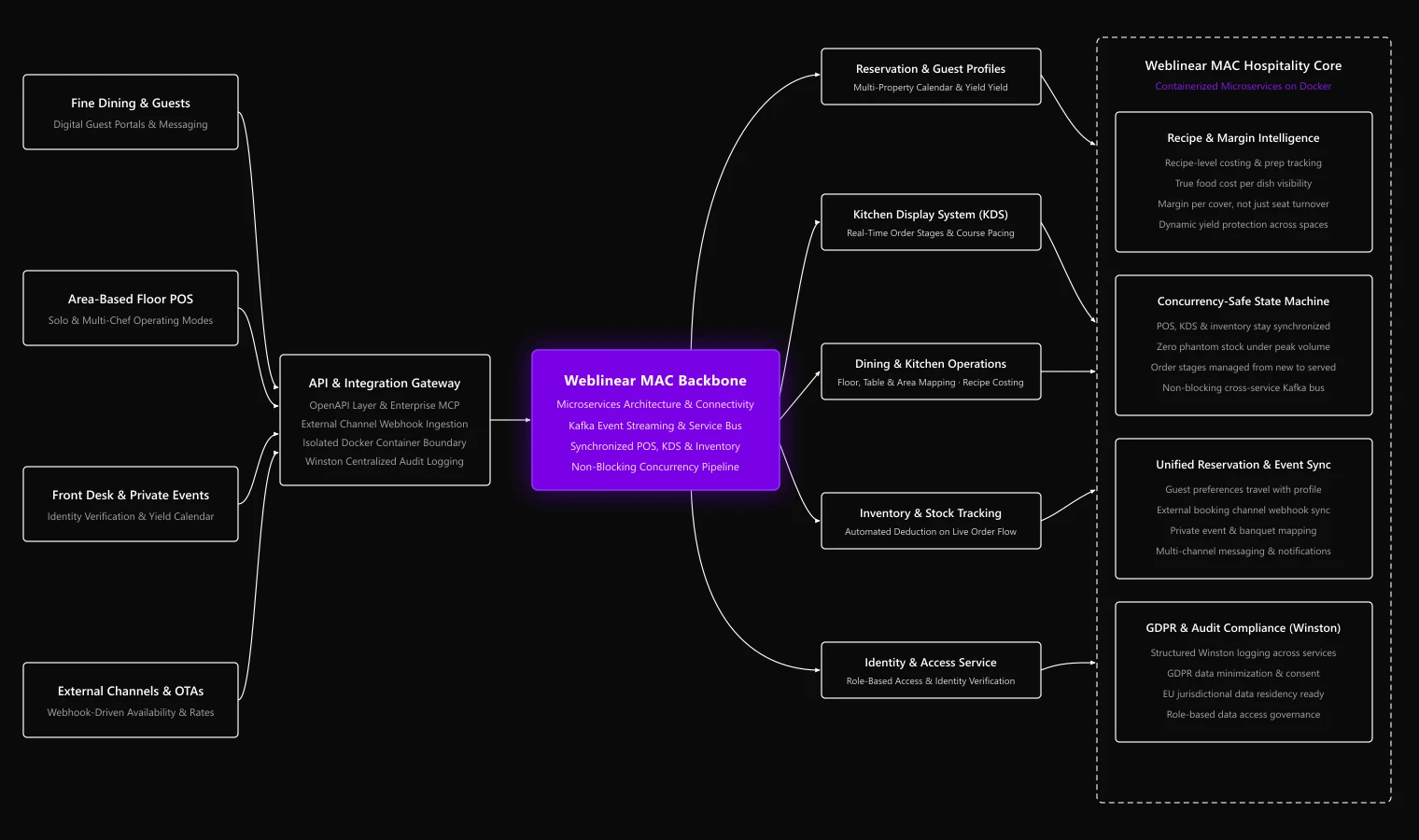
Fine Dining & Multi-Property Hospitality Architecture (Weblinear MAC)
Centralized event-driven topology engineered on Weblinear MAC (Microservices Architecture & Connectivity). Connects digital guest portals, POS terminals, and external channels via a governed API Gateway and Kafka streaming bus into containerized Docker services: Reservation & Guest Profiles, Dining & Kitchen Operations, Live KDS, and Identity & Access.
Why This Matters
A fine dining guest will not remember that the kitchen display synced correctly. They will remember whether the courses arrived at the right pace, whether the wine they liked last time was suggested again, and whether the evening felt effortless. The platform is built so that experience is the product of the architecture, not something staff have to compensate for despite the system. For ownership, that translates directly into margin per cover, protected yield on the highest-value tables and events, and a guest who comes back. For engineering leadership, it means a platform built on event-driven, containerized architecture that holds up under the exact concurrency conditions a full fine dining service creates.
The Outcome
Recipe-Level Cost Visibility: Gives management a real-time view of margin per dish, not just revenue per seat.
Live Kitchen Display Pacing: Course pacing is tracked and managed through a live kitchen display, keeping multi-course service consistent under full concurrent load.
Unified Reservation & Guest Profiles: Returning guests are recognized through a unified reservation and guest profile, not staff memory.
Operational Rigor for Private Events: Private events and banquet bookings run through the same operational rigor as nightly service, protecting the group's highest-margin business.
Automated Inventory & Waste Tracking: Inventory and waste are tracked automatically against real order flow, closing the gap between what was prepared and what was accounted for.
Governed Webhook Connectivity: External booking and distribution channels stay synchronized through governed webhook connectivity, without exposing internal systems.
Weblinear MAC Production Concurrency: The underlying Weblinear MAC architecture, event-driven, containerized, and access-governed, holds up under real production concurrency and meets the data protection standard a European operator is held to.
Unified Precision Engineering: What was previously dependent on staff memory and manual coordination now runs as one precision-engineered system, built to protect both the guest experience and the margin behind it.
Operational Priorities & Compliance Architecture
How the platform translates fine dining economics and European compliance into engineered systems.
Technical Metrics
Weblinear MAC & Kafka Event Streaming
Central event-driven orchestration backbone powered by Weblinear MAC, keeping kitchen displays, inventory, and reservation states consistent under high concurrent load.
Docker Service Isolation (Weblinear MAC)
Reservation & Guest Profile, Dining & Kitchen Operations, Identity & Access, and API & Integration Gateway each run as isolated Docker containers on Weblinear MAC.
Governed API & Webhook Gateway
OpenAPI layer, enterprise MCP, and external channel webhooks route through a governed gateway rather than direct service exposure.
GDPR-Aligned Data Governance
Guest profiles, reservation records, and preference data are managed with data minimization and consent in mind under EU data residency standards.
Centralized Structured Logging (Winston)
Winston-based logging runs across every service on Weblinear MAC, creating one queryable record of system activity and audit trails.
Running a fine dining operation on systems built for casual volume?
Weblinear builds hospitality platforms for operators where the guest experience cannot be rushed and the margins cannot be guessed. Weblinear can architect the platform built for precision instead.
